Finding Power of Factorial Divisor
Deep Dive into Finding the Power of a Factorial Divisor
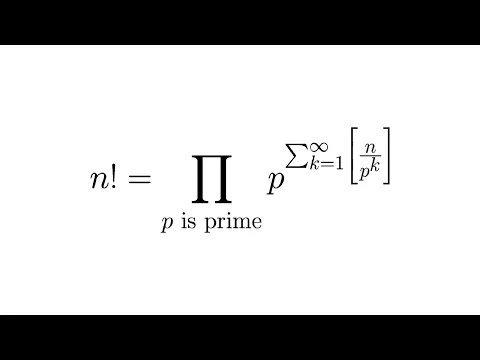
This algorithm is used to find the largest power x such that k^x divides n! , where n! is the factorial of a given number n , and k can be either a prime or composite number.
Why This Algorithm is Useful
In number theory and combinatorics, determining the largest power of a divisor for factorials is crucial in problems involving:
- Divisibility in large products (e.g., does n! divide a large power of some integer?)
- Prime factorization in combinatorial coefficients (e.g., the power of a prime factor in binomial coefficients)
- Factorial simplifications in modular arithmetic (useful in combinatorics, cryptography, etc.)
This algorithm is especially valuable because calculating n! directly for large n is computationally infeasible, but by using Legendre's formula, we can determine the power of a divisor without computing the factorial itself.
Video Explanation
Understanding the Problem for Prime k
Let's first consider the case where k is a prime number.
Example Problem: Power of Prime Factor Dividing n!
Suppose we want to find the largest power of a prime k = 2 that divides n! , where n = 10:
We need to find the highest power x such that 2^x divides 3628800.
Derivation of Legendre's Formula
-
Counting Divisors of Prime k :
The factorial contains various multiples of k, but not every number from 1 to n is divisible by k.
-
Step-by-Step Divisor Counting for Powers of k :
- First Power k : Every k-th number (i.e., every multiple of k) in the product from 1 to n contributes a factor of k . There are such numbers.
- Second Power k^2: Every k^2 -th number contributes an additional factor of k, so there are such numbers.
- Continuing for Higher Powers: This pattern continues until .
-
Summing Up All Factors of k:
By adding up the counts for each power of k , we get the largest power x such that k^x divides n! :
-
Example Calculation :
Let's compute this for n = 10 and k = 2 .
Thus, . So, is the largest power of 2 that divides 10!.
Implementation for Prime k
The code to compute this for prime k is as follows:
int fact_pow(int n, int k) {
    int res = 0;
    while (n) {
        n /= k;
        res += n;
    }
    return res;
}
Time Complexity
- Best Case: O(log_k n) for prime k. O(sqrt(k) + log n) for composite k.
- Average Case: O(log_k n) for prime k. O(sqrt(k) + log n) for composite k.
- Worst Case: O(log_k n) for prime k. O(sqrt(k) + log n) for composite k.
Space Complexity
- O(1) for prime k.
- O(log k) for composite k (to store the prime factors).
Explanation
For a prime k, Legendre's formula requires repeatedly dividing n by k, resulting in O(log_k n) time and O(1) space. For a composite k, the algorithm first factorizes k in O(sqrt(k)) time and stores up to O(log k) prime factors. Then, it applies Legendre's formula for each prime factor, yielding an overall time complexity of O(sqrt(k) + log n) and space complexity of O(log k).
Extending to Composite
When k is composite, we need to factorize k and determine how many times each prime factor of k appears in n!.
Example Problem: Power of Composite Divisor Dividing
Suppose n = 10 and k = 12. We want to find the largest power such that divides 10!.
-
Factorize :
We can see that k has prime factors 2 and 3 with respective powers 2 and 1.
-
Apply Legendre's Formula to Each Prime Factor:
- For , we previously found that the power of is .
- For , using the formula, we get:
Thus, the power of 3 in 10! is 4.
-
Calculate the Minimum Power Dividing :
- For , we need .
- For , we need .
The minimum of these two values is 4 , so 12^4 is the largest power of 12 that divides 10!.
Code Implementation for Composite
To implement this approach, we first factorize k and then use Legendre's formula for each factor.
#include <iostream>
#include <vector>
#include <cmath>
#include <climits>


// Function to find the largest power of a prime p that divides n!
int fact_pow(int n, int p) {
    int res = 0;
    while (n) {
        n /= p;
        res += n;
    }
    return res;
}


// Function to factorize k into prime factors and their powers
std::vector<std::pair<int, int>> prime_factors(int k) {
    std::vector<std::pair<int, int>> factors;
    for (int i = 2; i * i <= k; i++) {
        int count = 0;
        while (k % i == 0) {
            k /= i;
            count++;
        }
        if (count > 0) {
            factors.push_back({i, count});
        }
    }
    if (k > 1) {
        factors.push_back({k, 1});
    }
    return factors;
}


// Function to find the largest power of a composite k that divides n!
int composite_fact_pow(int n, int k) {
    std::vector<std::pair<int, int>> factors = prime_factors(k);
    int result = INT_MAX;
    for (auto &factor : factors) {
        int prime = factor.first;
        int power = factor.second;
        int power_in_factorial = fact_pow(n, prime);
        result = std::min(result, power_in_factorial / power);
    }
    return result;
}


int main() {
    int n = 10; // Example value
    int k = 12;  // Example composite number
    std::cout << "Largest power of " << k << " that divides " << n << "! is: "
              << composite_fact_pow(n, k) << std::endl;
    return 0;
}
Use Cases and Applications
This algorithm is widely useful in fields involving large combinatorial structures, especially when direct computation of n! is impractical:
- Divisibility Testing: In combinatorial problems where you need to check if n! divides a large power, this method efficiently finds the highest power.
- Factorization in Modular Arithmetic: In applications involving modular inverses or multiplicative groups.
- Cryptography: Particularly in algorithms like RSA or in solving Diophantine equations where factorial divisibility is often involved.
Conclusion
Legendre's algorithm is a highly efficient method for calculating the largest power of a divisor that divides a factorial. It plays a crucial role in number theory, combinatorics, and cryptography, where it provides an alternative to direct factorial computation, enabling efficient solutions for large numbers.
Test Your Understanding
Answer these 3 questions to check what you have learned.
What is the main topic of this documentation page?
What should be identified before implementing legendre algo?
How is understanding of legendre algo best checked?
Done with this topic? Mark it as complete to track your progress.
Was this page helpful?
Discuss this page
Have a question or spot something confusing in "Finding Power of Factorial Divisor"? Ask below. Backed by GitHub Discussions—maintainers receive system notifications directly.